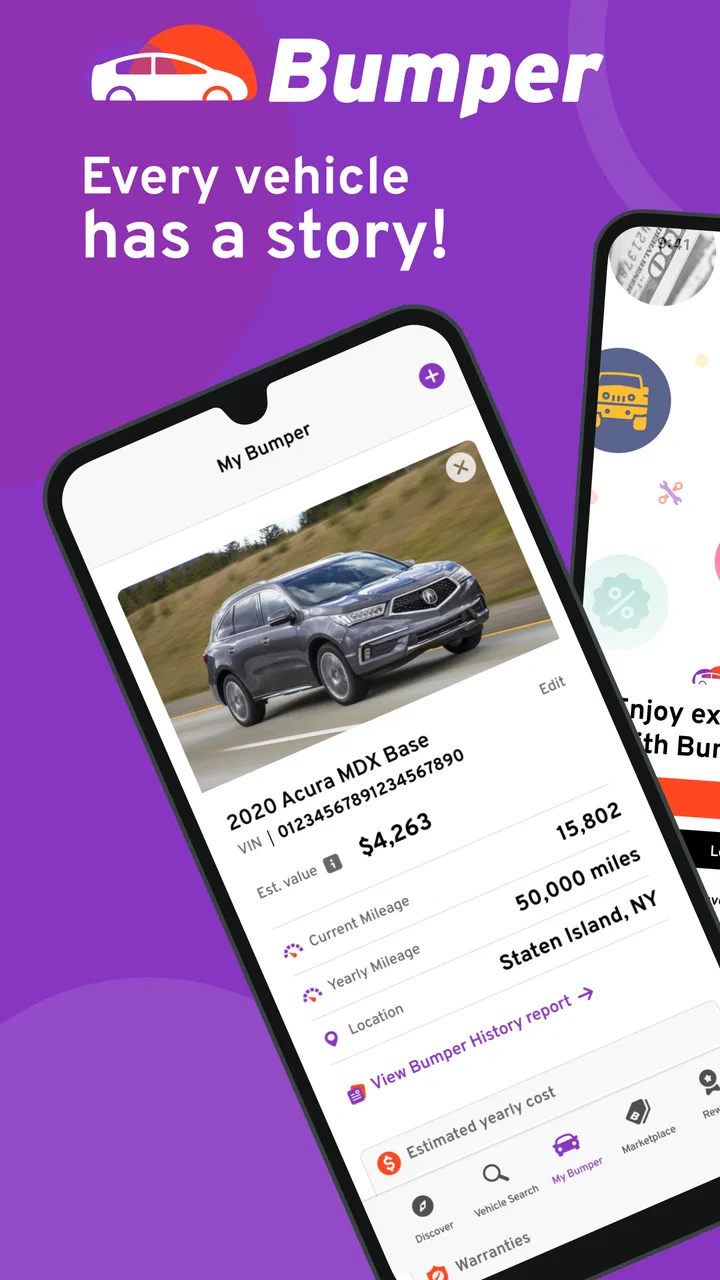
Bumper Vehicle History Reports
- 2.6
- Rating
- 100.00K
- Installs
- Free
- Price

 Analysis by App-foxy
I used Bumper Vehicle History Reports as a practical research tool when I wanted more context before judging a used vehicle. It sits in the Auto & Vehicles category and is made by Bumper, LLC. The basic appeal is easy to understand: instead of relying only on a seller’s description, I could look for vehicle-related information such as market value and theft records in one place. That makes it more useful during the early stages of shopping than after I have already committed to a purchase.
The app is free to install, is suitable for Everyone, and runs on Android devices using version 7.0 or later. It has passed the 100K+ installs mark, although its average score is a modest 2.6 from around 433 ratings and 226 written reviews. Those figures tell me to approach it as a potentially useful research aid rather than a universally loved, polished replacement for every other vehicle-checking method.
How Bumper fits into a used-car search
The strongest way to use Bumper Vehicle History Reports is as one step in a larger buying workflow. I would not treat a report as a final mechanical verdict. Instead, I would use it to organize questions: Does the asking price seem sensible? Is there a theft-related concern worth investigating? Does the vehicle deserve a closer inspection before I spend money on a mechanic or travel to see it?
You May Also Like

 Google Keep - Notes and lists
Google Keep’s Quiet Growth Shows the Appeal of Simpler Notes
As mobile work gets busier, Google Keep keeps winning a simple contest: capture a thought quickly, find it later, and get on with the day.

 Blood Strike: 2.5 Anniversary
Blood Strike’s Loadouts Turn Every Drop Into a Tactical Gamble
A close look at Blood Strike’s custom loadouts: how fast access to signature weapons reshapes its battle royale rhythm, rewards preparation, and narrows the gap between fights.

 Pandora - Music & Podcasts
Pandora’s Music Is Easy to Start, but Harder to Recover
Pandora’s strength is its low-effort path from a seed to a station. Its weak spot is how much confidence it asks you to place in connection, setup, and quiet recovery.

 8 Ball Pool
 Is Built on Rivalries, Rematches, and Routine
A close look at the rivalries, rematches, shared routines, and unanswered safety questions that turn a quick pool match into a persistent mobile community.

 Samsung Music
’s Quiet Strength Is Playing What You Already Own
Its reach comes less from spectacle than from dependable access to a personal library. That simplicity is both the app’s strongest retention engine and its ceiling.

 AccuWeather: Weather Radar
AccuWeather Review: A Quick, Clear Forecast for Everyday Decisions
For everyday plans, the best forecast is the one you can understand quickly. AccuWeather makes rain timing, radar, and local conditions easy to act on, with a few trade-offs.
More From Our News Desk



That distinction matters because vehicle research usually happens in stages. First, I might find several listings online. Then I narrow them by model, mileage, location, condition, and price. Bumper can help at the comparison stage, when I need to decide which vehicles deserve more attention. It is less convincing as a substitute for seeing the car, checking its documents, taking a test drive, and arranging an independent inspection.
The app’s focus on market values and theft records gives it a clear identity. It is not simply a general driving utility, navigation tool, or maintenance reminder. Its purpose is closer to a research companion for vehicles I own or may buy. That makes the experience especially relevant to shoppers who want information before contacting a seller, rather than drivers looking for something to use every day on the road.
What the free download really means
The word “free” is important, but I would read it carefully. The app itself can be downloaded without an upfront purchase, while in-app purchases are listed from $13.99 to $38.99 per item. In practical terms, that means I could begin exploring without paying immediately, but deeper or more complete use may involve a purchase. The free entry point is helpful for deciding whether the workflow suits me before spending anything.
I would not describe the app as an entirely free vehicle-history solution. The presence of paid items changes the value calculation, especially if I am checking several cars. Someone researching one serious candidate may view a paid report as a reasonable part of the shopping budget. Someone screening a long list of vehicles may find the cost harder to justify if every candidate requires a separate purchase.
The sensible approach is to identify the vehicle I am genuinely considering before paying for additional access. I would first remove obvious mismatches using the listing itself: unrealistic price, unsuitable trim, poor location, or condition that does not fit my needs. Then I would use Bumper on the smaller group of candidates. That workflow protects the free access from becoming an excuse to investigate every interesting listing indiscriminately.
There is also a difference between information value and purchase value. A report can help me avoid wasting time on a questionable vehicle, but it does not guarantee that the car is mechanically sound or that the seller’s paperwork is complete. I would therefore compare the cost of using the app with the cost of traveling to inspect a vehicle, paying for a pre-purchase inspection, or discovering a serious problem later. The right comparison is not “free app versus no app”; it is “research expense versus the risk and inconvenience of making a poor shortlist.”
Where the app can save time
One of the less obvious benefits is that Bumper can help structure a conversation with a seller. If the market-value information makes the asking price look high, I would not immediately assume the seller is dishonest. Instead, I would ask about condition, service history, equipment, ownership history, and any work recently completed. The report becomes a prompt for better questions rather than a single number that ends the discussion.
The same principle applies to theft records. A result connected with theft deserves careful attention, but I would verify the situation through official documentation and the relevant authorities before drawing a conclusion. Vehicle records can be misunderstood when identifiers are entered incorrectly or when the information needs context. The useful action is to pause the purchase and investigate, not to rely on a screen as the only evidence.
I also found the app more valuable as a comparison tool than as a one-time curiosity. If I am choosing between two similar vehicles, I can use the available information to decide which one deserves a physical inspection first. That is a better use of a paid report than checking a car simply because its listing appeared in my feed.
For a private seller, the app may also help prepare for a negotiation. I could research my own vehicle before listing it, then set expectations around the asking price instead of choosing a figure based only on similar advertisements. However, I would still treat market value as guidance. A vehicle’s actual worth can shift with condition, location, equipment, maintenance, and urgency, so I would not present the app’s estimate as an official appraisal.
What Bumper cannot replace
The biggest tradeoff is the boundary between records and reality. A vehicle can have a clean-looking history and still need expensive repairs. A report may raise a concern, but it does not replace a mechanic who can inspect the engine, transmission, suspension, tires, brakes, frame, and signs of accident repair. For a costly purchase, I would budget for both digital research and a physical inspection.
I would also avoid assuming that a market-value result tells me whether a particular listing is a good deal. The number may be a useful reference point, but a car with exceptional maintenance may deserve more than a neglected example of the same model. Conversely, a low price may reflect hidden problems rather than a bargain. The app can sharpen my questions, but it cannot make the judgment for me.
Another friction point is the app’s overall rating. An average of 2.6 is not a reason to dismiss it automatically, but it is a clear signal to keep expectations realistic. I would pay attention to how smoothly the app handles my vehicle search and whether the results are understandable before committing to paid access. If the experience feels unclear or if I cannot confidently connect the result to the vehicle I am researching, I would stop rather than spend more.
The paid range also creates a meaningful tradeoff for high-volume shoppers. A dealer, reseller, or enthusiast comparing many vehicles may need a different tool or a service with a pricing model designed for repeated research. Bumper may make more sense for an individual who has narrowed the search to a few serious candidates. The app’s value is therefore tied not only to the information it presents but also to how many vehicles I need to examine.
Everyday buying scenario
Imagine I find a used car that looks attractive because the seller has priced it below similar listings. Before arranging a long trip, I would enter the vehicle details into Bumper and review the available information. If the market-value context supports the idea that the price is unusually low, I would treat that as a reason to ask more questions, not as proof of a bargain. I would ask for maintenance records, ownership documents, and permission for an independent inspection.
If theft-related information appears, I would stop the process until the seller can explain the record and provide documentation that the vehicle can legally be transferred. I would not send a deposit simply because the listing is cheap or because the seller is pressuring me to decide quickly. In this scenario, the app’s most useful contribution is not a dramatic discovery; it is helping me slow down before money changes hands.
If the results do not raise an obvious concern, I would still inspect the car in person and verify the vehicle identification details against the car and its paperwork. I would then use the report as one piece of the negotiation. That workflow keeps Bumper in its proper role: a screening and questioning tool that can improve preparation without pretending to eliminate uncertainty.
Who is likely to get the most value
I think the app is best suited to a private buyer who is actively comparing used vehicles and wants a convenient starting point for market-value and theft-related research. It can be particularly useful when listings are spread across different sellers and I need a consistent way to decide which cars deserve time. The free installation lowers the barrier to trying that process, while the paid items make it important to narrow the shortlist first.
It may also suit someone selling a vehicle who wants another reference while preparing an asking price. I would use it to support a broader review of comparable listings, not as the sole basis for pricing. A seller can benefit from knowing which questions a buyer may ask, especially when the vehicle has changed hands or has a complicated background.
I would be more cautious recommending it to professional dealers, frequent resellers, or anyone who needs a large number of checks. The listed per-item purchase range could become a significant expense when repeated across many vehicles. Those users should compare the total cost of their workflow with services built for regular commercial research, while remembering that Bumper’s free starting point may still be useful for occasional checks.
I would skip it if I only want maintenance reminders, navigation, fuel tracking, roadside assistance, or a diagnostic tool. Those needs belong to other types of automotive apps. I would also skip relying on it alone for a high-value purchase. In that situation, a qualified inspection and direct document verification are more important than the convenience of any phone-based report.
How it compares with familiar alternatives
The usual alternative is simply searching listings and comparing asking prices. That costs nothing, but it can encourage me to compare vehicles that are not truly equivalent. Bumper adds a research layer by focusing on information connected with the vehicle itself, including market values and theft records. Its advantage is organization; its weakness is that the result still needs interpretation.
Another alternative is asking a mechanic to inspect the car first. That is stronger for physical condition but may be wasteful when I am still choosing among many listings. I would use Bumper earlier, then reserve the mechanic for the finalists. This two-stage approach can be more efficient than paying for an inspection on every vehicle that looks promising online.
Official records and direct document checks are another important comparison. They may be necessary when a report raises a serious concern, particularly around ownership or theft. Bumper can help me know what to investigate, but I would not let it replace official confirmation. In other words, the app is most valuable between casual browsing and formal verification, where it can turn a vague suspicion into a specific question.
My verdict on paying for deeper access
My recommendation is conditional rather than enthusiastic. The free download is worth trying if I am shopping for a used vehicle and want a focused way to begin checking market context and theft-related information. I would not pay automatically. I would first see whether the app gives me clear, relevant results for a vehicle I am seriously considering and whether those results improve my next decision.
Paid access can make sense when one report helps me avoid a wasted trip, exposes a reason to demand documentation, or gives me a more informed starting point for negotiation. It is harder to justify when I am merely browsing, checking many vehicles, or expecting a complete mechanical assessment. The listed purchase range means I should decide in advance how many checks fit my budget.
Version 10.0.54 is the current version, and the app’s broad Android compatibility makes it accessible to users on relatively older devices. Still, the rating of 2.6 means I would keep a backup plan: save important listing details, verify the vehicle identification information carefully, and use independent inspection and official records when the purchase matters.
Overall, I see Bumper Vehicle History Reports as a focused first filter, not a complete buying solution. Its best value comes from helping me choose what to investigate next, not from promising certainty. If I were buying one used car and wanted an extra research step before arranging an inspection, I would try the free version and pay only when a specific report could genuinely influence the decision. If I needed dependable high-volume checks or a mechanical diagnosis, I would choose a different service and rely on professionals for the final judgment.
FAQs for Bumper Vehicle History Reports
01What is Bumper Vehicle History Reports?
Bumper Vehicle History Reports is a vehicle research service designed to help users learn more about a used car before buying it. By entering identifying information such as a vehicle identification number (VIN), users may access available records related to ownership, accident history, title status, mileage, recalls, and other reported events. The amount of information can vary depending on the vehicle and the records available.
02How do I search for a vehicle report in Bumper?
To search for a report, you generally need to enter the vehicle’s VIN or other requested details in the search field. After submitting the information, Bumper processes the request and displays the records it can locate. During testing, the process was straightforward, but users should carefully review the vehicle details shown to make sure the report belongs to the correct car before relying on the results.
03Is Bumper Vehicle History Reports free to use?
Bumper may allow users to begin a vehicle search without charge, but accessing complete report details can require payment or a subscription, depending on the current offer and platform terms. Before completing checkout, carefully read the pricing information, billing frequency, trial conditions, and cancellation policy. Prices and available plans may change, so confirm the final cost directly in the app or official service.
04Can Bumper guarantee that a vehicle has never been in an accident?
No vehicle history service can guarantee that its report contains every accident, repair, or ownership event. Bumper relies on information supplied by public agencies, insurers, dealerships, auctions, service providers, and other data sources. Unreported damage, incomplete records, title issues, or events that occurred recently may not appear. Use the report as a research tool and arrange an independent inspection before purchasing.
05Is Bumper useful when buying a used car?
Bumper can be useful as an initial screening tool when comparing used vehicles. A report may reveal warning signs such as inconsistent mileage, salvage or rebuilt titles, reported accidents, multiple owners, recalls, or registration history. However, it should not replace a professional mechanical inspection, a test drive, or verification of the seller’s documents. Review the report alongside maintenance records and an independent vehicle inspection.
Pros
- Quickly reveals reported accidents and title problems before buying.
- VIN-based searches help verify a vehicle’s identity and history.
- Useful for comparing multiple used cars during the shopping process.
- Report results are presented in a straightforward
- easy-to-read format.
- Can expose mileage inconsistencies that may indicate odometer fraud.
Cons
- Coverage may vary depending on the vehicle’s age
- state
- and reporting sources.
- A clean report cannot guarantee that a car has never had hidden damage.
- Full reports or additional checks may require payment or in-app purchases.
- Some records may be delayed
- incomplete
- or missing from the database.
- VIN entry errors can produce inaccurate results or information for another vehicle.

Bumper Vehicle History Reports
Gallery